
The best space books do more than describe stars and galaxies — they fundamentally reshape how we understand reality. From black holes and relativity to cosmic expansion and quantum mechanics, great space books bridge the gap between advanced physics and everyday curiosity.
Authors like Stephen Hawking, Carl Sagan, Albert Einstein, Neil deGrasse Tyson, Brian Cox and Sean Carroll have made cosmology accessible without diluting scientific depth. Their space books explain where we come from, how gravity shapes galaxies, why time bends, and how physical laws govern everything — from planetary motion to the atoms in our bodies.
Reading well-written space books expands perspective, strengthens analytical thinking, and anchors wonder in evidence. If you are looking for the best space book recommendations, this curated list will help you explore the universe with clarity.
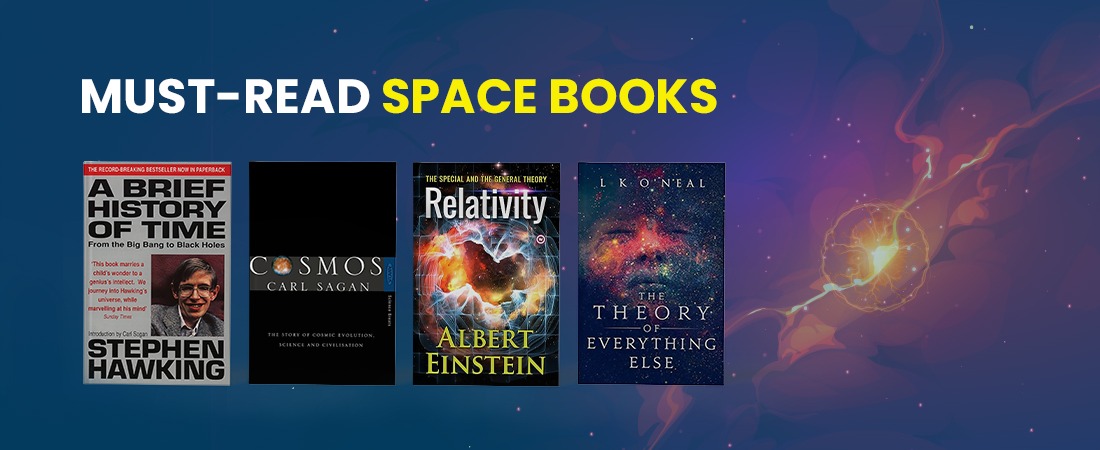
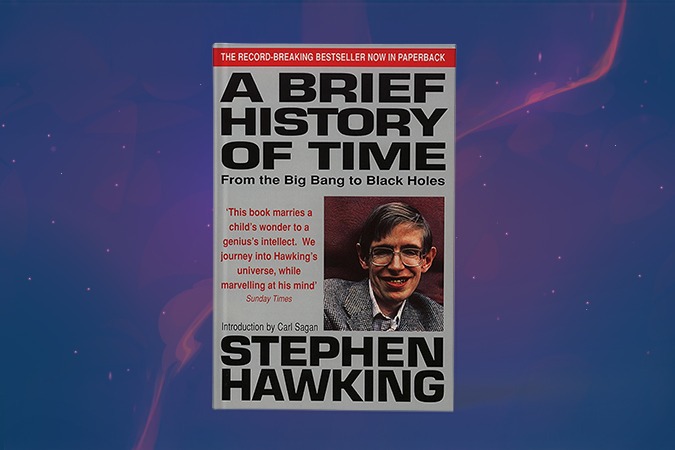
One of the most influential space books ever written, A Brief History of Time explains black holes, the Big Bang, singularities, and the nature of time itself. Hawking simplifies complex astrophysics without oversimplifying it. He introduces readers to quantum theory, spacetime curvature, and the search for a unified theory of physics.
This space book remains a benchmark for popular cosmology because it balances scientific rigour with readability.
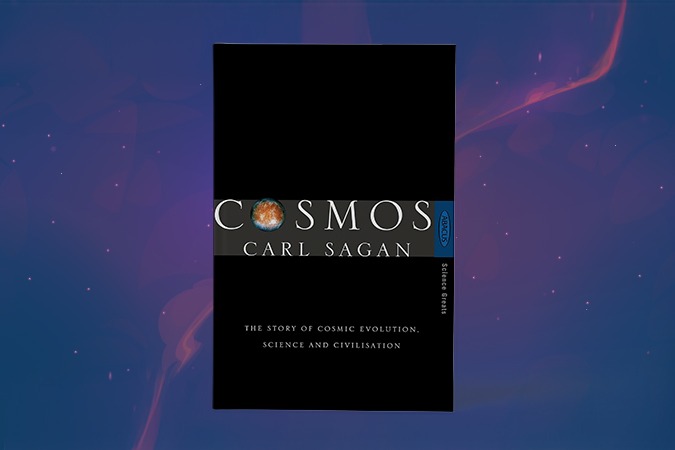
By Carl Sagan
Among the most enduring space books, Cosmos blends astronomy, planetary science, and philosophical reflection. Sagan explores the evolution of stars, the history of scientific discovery, and humanity’s fragile position in a vast universe. Unlike purely technical space books, Cosmos connects scientific facts with human meaning, making it both intellectually grounding and emotionally expansive.
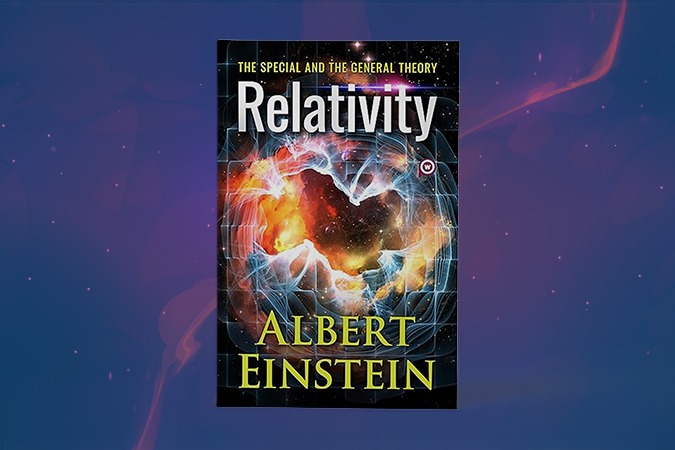
This foundational work is Einstein’s own explanation of relativity. It explains how gravity bends space and time – ideas central to modern cosmology and black hole research.
Although more conceptual than narrative, this space book provides unmatched insight into how gravitational theory reshaped physics. It is essential reading for anyone serious about understanding the structure of the universe.
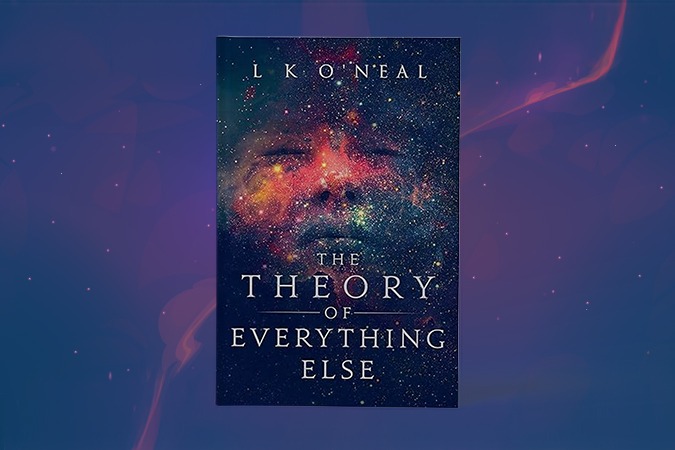
By LK O’ Neal
This book explores the scientific ideas that exist on the edges of mainstream cosmology. It examines unanswered questions, speculative physics, and the “everything else” beyond neat equations.
For readers who enjoy space books that question assumptions and explore theoretical boundaries, this title broadens the conversation beyond standard cosmological models. L
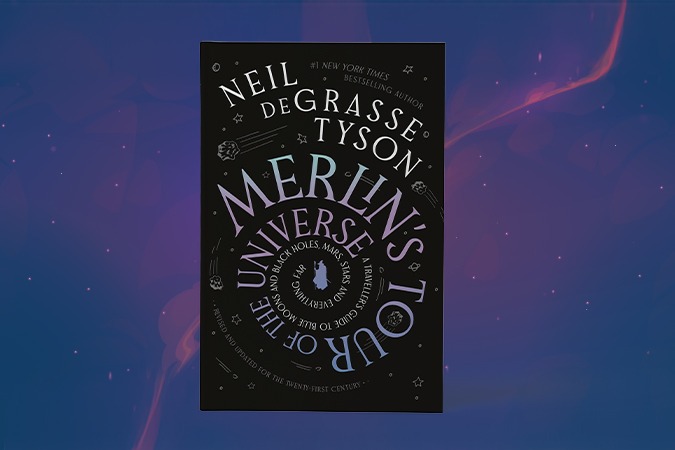
Among the most imaginative space books for curious readers, this title follows Merlin, a fictional cosmic traveller, as he answers big questions about gravity, light, space, and time. Blending humour, science, and playful illustrations, Tyson explains stars, galaxies, black holes, and planetary motion with clarity. This engaging space book makes complex astrophysics accessible to both adults and young astronomy enthusiasts.
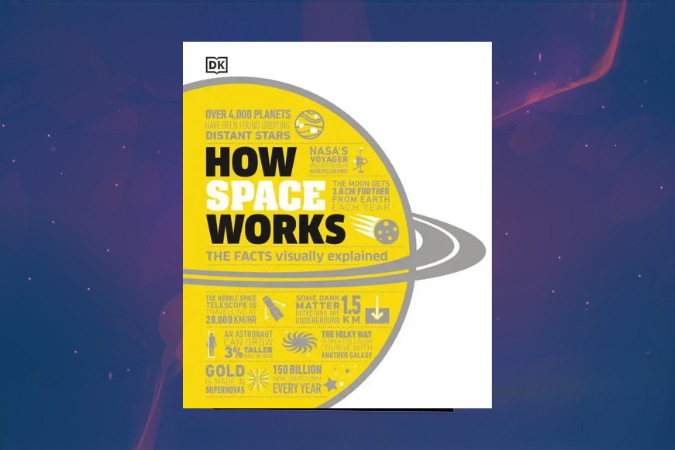
One of the most visually engaging space books for beginners, this illustrated encyclopedia breaks down astronomy through step-by-step graphics and jargon-free explanations. From the Solar System and the Milky Way to dark matter, cosmic rays, and black hole collisions, it makes complex space science accessible. Packed with clear visuals, bite-sized facts, and up-to-date discoveries, this space book is ideal for curious readers exploring the universe.
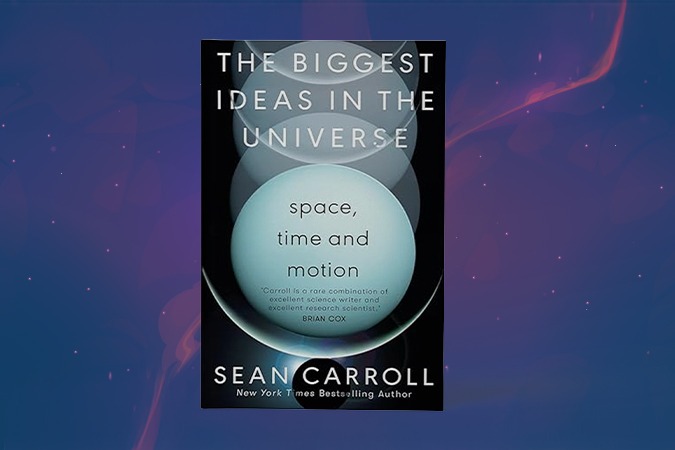
By Sean Carroll
One of the most intellectually ambitious space books of recent years, this title explains the equations behind modern physics. Sean Carroll makes calculus, general relativity, quantum mechanics, and black hole theory accessible without diluting their depth. Instead of avoiding mathematics, he reveals how equations elegantly describe reality, guiding readers toward a deeper understanding of spacetime and the structure of the universe.
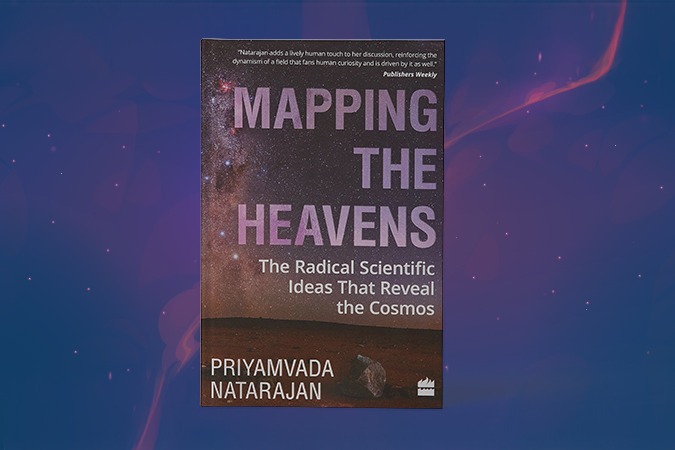
One of the most insightful modern space books, this work traces the revolutionary discoveries that reshaped cosmology — from dark matter and dark energy to black holes and the accelerating universe. Astrophysicist Priyamvada Natarajan explains how cosmic maps are built and why scientific breakthroughs are often contested before acceptance. Blending history and cutting-edge research, this space book reveals how our understanding of the universe continues to evolve.
Space books are not just about distant galaxies. They explain the origin of the universe, the nature of matter, and the physical laws that govern life on Earth. In an age where misinformation spreads easily, reading well-researched space books strengthens scientific literacy and critical reasoning.
More importantly, they recalibrate perspective. When you understand cosmic scale, everyday anxieties shrink. That shift in scale is one of the quiet, powerful effects of reading the best space books.
A Brief History of Time, Cosmos, and Merlin’s Tour of the Universe are strong starting points for readers new to space science.
Black Holes by Brian Cox and Jeff Forshaw provides a focused and modern explanation of black hole physics.
Some space books involve complex physics, but many are written for general readers and require curiosity more than technical background.
Space science explains the origin of the universe, the laws of physics, and humanity’s place in cosmic history. It strengthens scientific literacy and critical thinking.
Most popular space books minimize equations and focus on conceptual understanding, making them accessible to non-scientists.