
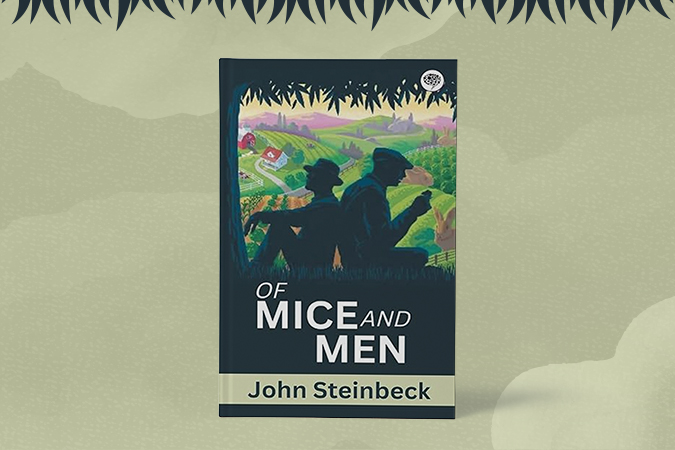







The Of Mice and Men John Steinbeck book remains one of the most powerful works of American literature. First published in 1937, this classic novella explores friendship, fragile dreams, loneliness, and survival during the Great Depression. Rather than focusing on grand historical events, Steinbeck turns his attention to ordinary working men struggling with poverty, isolation, and hope.
Through a tightly structured and emotionally charged narrative, Steinbeck shows how companionship and aspiration shape human endurance — even when circumstances seem impossibly harsh.
In this article, we’ll explore a clear summary of the novel, its major themes, insights into John Steinbeck’s life, and why Of Mice and Men continues to resonate with modern readers.
At its core, the Of Mice and Men John Steinbeck book follows two migrant workers: George Milton and Lennie Small, who travel together in search of farm work in California.
George is sharp, cautious, and protective. Lennie is physically powerful but intellectually disabled, with a childlike innocence that often leads to trouble. Despite their differences, the two share a powerful bond, and a dream.
Their dream? To own a small piece of land where they can live independently, work for themselves, and “live off the fatta the lan’.” This dream symbolises dignity, stability, and freedom — luxuries denied to most migrant labourers of that era.
However, the ranch where they find work becomes a space where social hierarchy, prejudice, and vulnerability collide. As tensions rise and circumstances spiral beyond control, Steinbeck delivers one of the most heartbreaking conclusions in modern literature.
At its centre, the novel argues that human connection is often the only defence against crushing loneliness.
The relationship between George and Lennie forms the emotional core of the Of Mice and Men John Steinbeck book. In a world where most ranch workers drift alone from job to job, their companionship stands out. George sacrifices freedom to protect Lennie. Lennie depends entirely on George for guidance and safety. Their bond challenges the harsh individualism of the Great Depression era.
Power on the ranch takes many forms like physical strength, social authority, economic control, and gender and racial hierarchy. Yet vulnerability cuts across every character, from Crooks, isolated by racism, to Curley’s wife, trapped by sexism, to Candy, discarded because of age. Steinbeck shows that even the powerful are often deeply insecure.
Almost every character in the novel is lonely. Racism, disability, gender bias, and economic instability create emotional walls between people. The Of Mice and Men John Steinbeck book exposes how systemic inequality deepens personal isolation. The tragedy of the story lies not just in what happens, but in how alone each character ultimately is.
John Steinbeck was born in 1902 in Salinas, California — a setting that deeply influenced his writing. Growing up in an agricultural region, he observed first-hand the struggles of migrant workers and rural communities.
He briefly attended Stanford University but left without completing a degree, choosing instead to pursue writing full-time. His works often explored social inequality, economic hardship, migration, and the dignity of working-class lives.
In 1962, Steinbeck was awarded the Nobel Prize in Literature. Today, he is remembered as one of America’s most important literary voices. His books remain staples in classrooms worldwide for their historical insight and psychological and emotional depth.
A powerful story of the Joad family, forced to leave Oklahoma during the Dust Bowl. The novel follows their migration to California and exposes exploitation, poverty, and the collapse of the American Dream.
A multi-generational family saga set in California’s Salinas Valley, exploring themes of good versus evil through the intertwined lives of the Trask and Hamilton families.
Set in Monterey during the Great Depression, this novel portrays a quirky group of residents whose interconnected lives reveal humour, struggle, and unexpected kindness.
A non-fiction account of Steinbeck’s road trip across America with his poodle, Charley, reflecting on cultural change and national identity.
The themes explored in the Of Mice and Men John Steinbeck book remain deeply relevant:
Modern readers still recognise the fragility of dreams in uncertain economies. We still see how systems fail vulnerable individuals. And we still crave connection in isolating times.
That’s why this slim novella continues to hold extraordinary power.
What is the main idea of the Of Mice and Men John Steinbeck book?
It explores friendship, loneliness, fragile dreams, and survival during economic hardship.
Is Of Mice and Men based on real events?
Not directly, but it reflects the real conditions faced by migrant workers during the Great Depression — many of whom Steinbeck observed personally.
Why is Of Mice and Men so popular in schools?
Its accessible language, short length, emotional impact, and layered themes make it ideal for literary study and discussion.
Is Of Mice and Men suitable for beginner readers?
Yes. The language is simple and direct, though the themes encourage deeper reflection.
Does the novel address social issues?
Absolutely. It touches on racism, disability, gender inequality, class struggle, and systemic injustice.